Parents
Are you concerned about your children spending excessive amounts of time on their smartphones and computers ?
Why don’t we transform children’s favorite screen time into learning something new with fun ?
will understand the coding algorithm in the world of Metaverse and AI
without learning difficult text coding.
Beyond Simple Syntax: 3 AI-Era Superpowers for Young Minds
In an era where generative AI can write simple code in seconds, what truly matters for your child? Robogram’s Beginner curriculum transitions students from passive game consumers into curious system architects. Through real-time 3D world creation, children develop the essential cognitive habits required in an artificial intelligence society.
🌟 How Jem S Level 1 Cultivates Future-Ready Competencies
Witness how your child transforms from playing games to commanding complex digital environments.
The Art of Inquiry & Prompting
Rather than copying fixed formulas, students define the questions first. They formulate structured conditional logic—specifying exact coordinates, speed variables, and trigger events in Roblox Studio. This teaches children how to structure precise, unambiguous prompts that computers and AI models understand.
Metacognitive Problem Solving
When a physics jump fails or a timer loop runs too quickly, the 3D visual feedback is instantaneous. Students observe where their hypothesis broke down, inspect variable values, and iteratively refine their logic without fear of failure—building supreme emotional resilience and metacognitive awareness.
Communicating with Digital Systems
Children experience coding as a vibrant dialogue with an interactive system. By snapping visual blocks into cause-and-effect event listeners (Touches, Timers, Coordinates), students gain intuitive mastery over how computational brains process real-world rules and instructions.
📚 Official Level 1 Spiral Curriculum (Books 1–6)
Each full-color workbook provides structured step-by-step challenges, taking elementary learners from initial spatial coordinates to independent 3D game publishing.
Book 1: 3D Metaverse Basics
Spatial coordinates, world anchors, spawn physics.
Book 2: Physics Jump Logic
Velocity pads, gravity jump calculations, friction.
Book 3: Dynamic Obstacles
Timer loops, disappearing platforms, sequence triggers.
Book 4: Checkpoints & States
Multi-stage checkpoints, scoreboards, player state flags.
Book 5: Variables & Branching
Numeric variables, Boolean conditionals, custom functions.
Book 6: Game Capstone & Launch
Playtesting, UI score counters, public world publishing.
📺 Sample Lesson Walkthrough Video
Watch how an elementary beginner builds intuitive physics logic and tests obstacles in real time.
🎯 Tangible Milestones Your Child Will Confidently Articulate
Here is the real, measurable cognitive growth you will observe at home after completing Level 1:
Experiencing Artificial Intelligence: From Data to Discovery
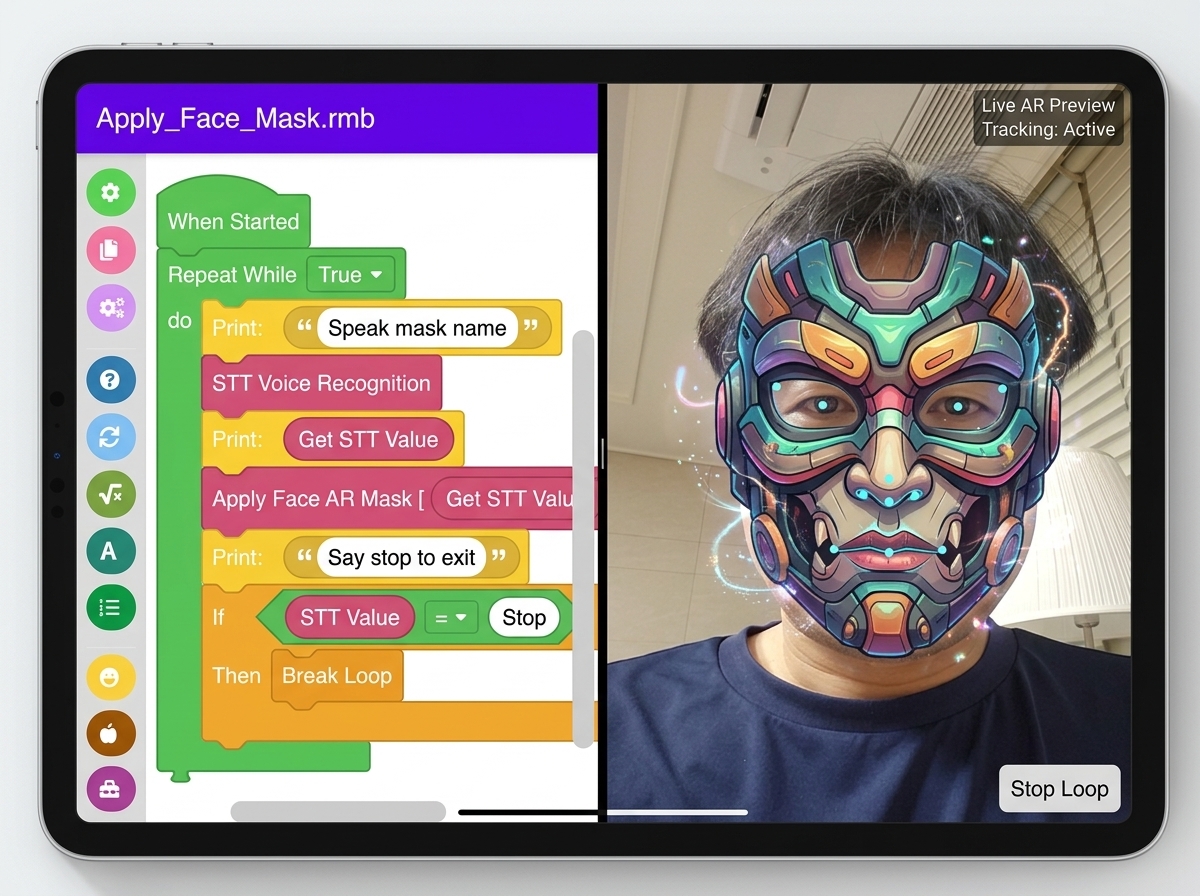
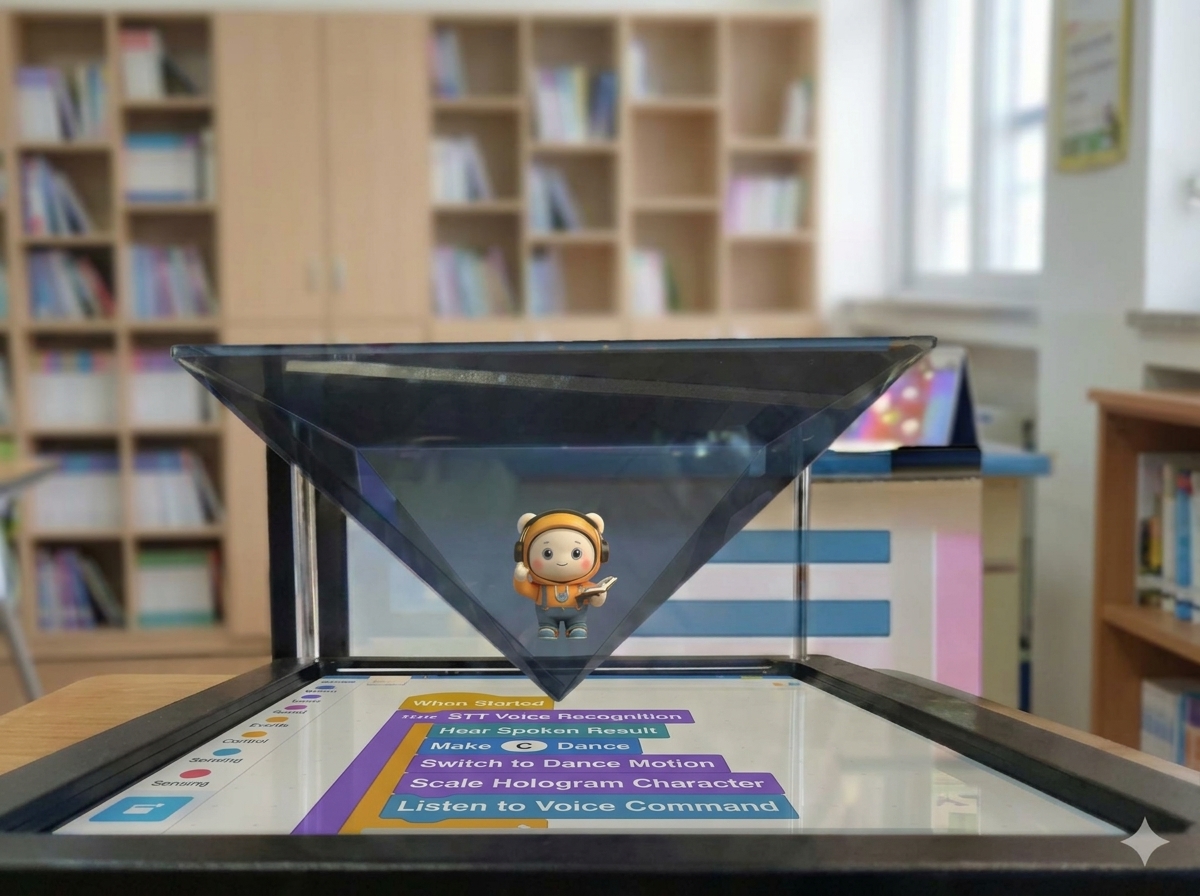
Children interact with AI daily, yet few understand how it thinks. With the Robome Mobile App, young students collect photo and audio datasets, train neural networks in seconds on their tablets, and see their own AI come alive through 3D holographic projections and augmented reality masks.
🌟 How Robome Mobile App Cultivates Future-Ready Competencies
Demystifying machine learning so children become confident masters of AI technology.
Inquiring Into How AI “Sees”
Children question data quality and sample diversity. By asking *”What angles and lighting does the neural network need to recognize my expression accurately?”*, students grasp the foundational principles of artificial intelligence data collection and hypothesis testing.
Evaluating Confidence Scores
Students inspect real-time classification probability bars. When the AI is uncertain, children actively evaluate the training sample balance, add diverse examples, retrain the model, and observe the accuracy increase—learning empirical scientific reasoning.
Multimodal Human-AI Dialogue
Students program bidirectional interactions: speaking voice commands triggers 3D hologram dance routines, while smiling or frowning instantly overlays matching AR cyber masks. Students learn that AI is a responsive partner that can be commanded through multimodal input.
🚀 Core AI Projects in the Robome Mobile Curriculum
Students build engaging, physical and augmented-reality AI applications using ordinary classroom tablets or smartphones.
3D Hologram Projection & Character Dance Motion AI
Students build a physical 3D reflection prism and train machine learning models so their virtual 3D character dances, reacts to voice cues, and changes choreography dynamically based on on-device neural network recognition.
Real-Time Facial Expression Analysis & AR Mask Synthesis
Students program computer vision pipelines that analyze live facial landmarks and emotional states, automatically overlaying interactive AR cyber masks that mimic students’ expressions in real time.
📺 Robome Mobile Classroom Demonstration
Watch elementary students collect training datasets, train neural models on-device, and test audio-visual AI applications.
🎯 Tangible Milestones Your Child Will Confidently Articulate
Measurable AI literacy outcomes your child gains from the Robome Mobile experience:
Systems Thinking: Guiding Students from Coders to Architects
In middle school, cognitive development shifts toward abstract systems and interrelationships. Jem S Level 2 challenges students to architect complete multiplayer worlds with dynamic quests, item economies, and server-synchronized states, fostering high-order metacognition and algorithmic reasoning.
🌟 How Jem S Level 2 Cultivates Future-Ready Competencies
Developing systemic thinking, root-cause debugging, and sophisticated logical structuring.
Designing Multi-Branch System Questions
Students no longer ask simple linear questions. They frame systemic inquiries: *”How do we structure an inventory table so players can trade without infinite duping?”* They design modular prompt conditions and state machine diagrams before writing any logic blocks.
Systemic Root-Cause Debugging
Multiplayer bugs cannot be solved by guesswork. Students trace variable scope across client and server boundaries, inspect event payloads, and isolate concurrency issues. This teaches disciplined analytical problem-solving and rigorous mental models.
Interactive NPC Dialogue Trees
Students engineer dynamic branching conversation trees for in-game characters. By linking dialog choices with state variables and conditional rewards, students master the foundations of conversational UX and generative AI prompt trees.
📚 Official Level 2 Systems Curriculum (Books 7–12)
Students progress through structured modules building advanced quest logic, economy systems, and collaborative game experiences.
Book 7: Advanced World Systems
Terrain modeling, atmospheric lighting, spatial audio.
Book 8: Inventory & Tables
Array handling, inventory management, item pickups.
Book 9: Quest Branching Logic
Multi-condition quest triggers, NPC dialog state trees.
Book 10: In-Game Economy
Coin spawners, merchant shops, transaction validations.
Book 11: Multiplayer Mechanics
Team spawns, player vs. player zones, leaderboard sync.
Book 12: Adventure RPG Launch
Complete capstone integration, beta testing, store release.
⚔️ Capstone Project: Adventure RPG & World Quest Engine
Students connect inventory tables, combat mechanics, and dynamic NPC encounters into an interconnected gaming world.
🎯 Tangible Milestones Your Child Will Confidently Articulate
The measurable intermediate systems capabilities your child demonstrates:
Biometric AI: Bridging Human Kinematics with Digital Twins
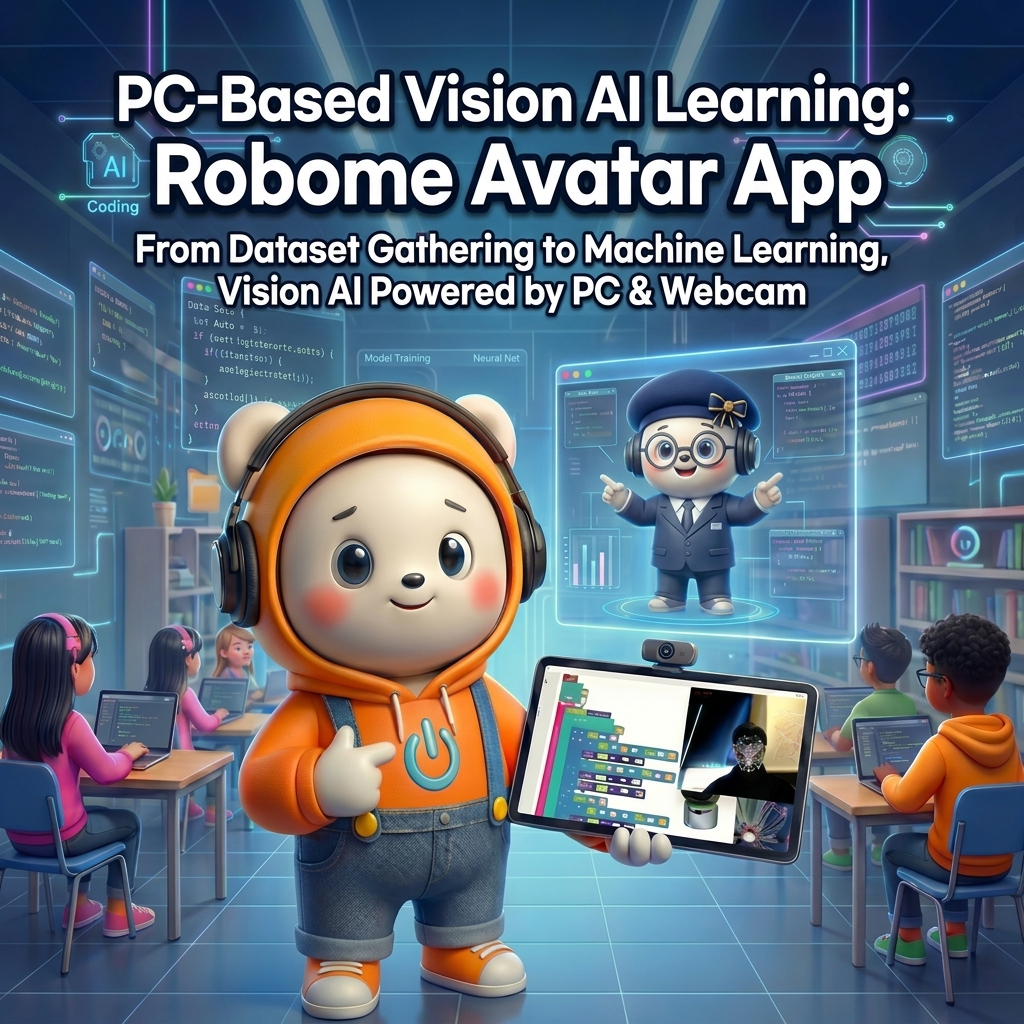
How do high-end computer vision systems track human motion and sentiment? In Robome PC Avatar, students utilize cutting-edge 468-point facial landmark tracking to bring 3D digital avatars to life. Children learn the exact geometric vector mathematics that power modern face filters, virtual influencers, and metaverse avatars.
🌟 How Robome PC Avatar Cultivates Future-Ready Competencies
Mastering biometric computer vision, landmark kinematics, and intelligent game algorithms.
Inquiring into Coordinate Spaces
Students investigate landmark geometry. By asking *”How do the distance vectors between eyebrow points #70 and #107 indicate surprise?”*, students connect middle school coordinate geometry with real-world computer vision machine learning.
Biometric Threshold Calibration
Students analyze noise thresholds and smoothing filters. When tracking fluctuates under different lighting conditions, students learn to calibrate mathematical thresholds, developing disciplined sensory calibration and critical evaluation skills.
Direct Biometric Collaboration
Students move beyond typing and mouse clicks. By programming hands-free gestural controllers and competing against intelligent Gomoku AI heuristic engines, students discover how natural human kinematics can orchestrate intelligent computing systems.
🎥 Biometric Landmark & Real-Time 3D Digital Twin
Students map 468 facial mesh coordinates from a standard PC webcam directly onto 3D character avatars with zero specialized motion-capture hardware.
🎯 Tangible Milestones Your Child Will Confidently Articulate
Measurable computer vision and AI skills your child will demonstrate:
Engineering for Scale: Cloud Architecture & Networked Systems
Preparing secondary students for university STEM and real-world technology innovation. In Jem S Level 3, students master cloud database persistence (DataStores), asynchronous network events, and high-performance physics simulations, graduating from casual coders to professional software engineers.
🌟 How Jem S Level 3 Cultivates Future-Ready Competencies
Architecting enterprise-grade cloud persistence, network synchronization, and monetization logic.
Architecting Cloud Boundary Contracts
Students formulate deep engineering specifications: *”What retry policies and error-handling wrappers are required when calling external cloud DataStore APIs?”* Students learn how professional cloud architectures guarantee ACID transactions and data persistence.
Performance Profiling & Optimization
Students utilize developer performance profilers. They analyze memory usage, identify redundant network replication packets, and optimize algorithmic complexity (Big-O principles), building professional self-auditing habits.
Client-Server Network Dialogue
Students program RemoteEvents and RemoteFunctions. They engineer secure two-way handshake protocols between untrusted client devices and authoritative cloud game servers, preventing client-side hacking and race conditions.
📚 Official Level 3 Enterprise Curriculum (Books 13–18)
Students architect full-scale commercial experiences equipped with cloud database persistence, custom shaders, and cross-server global matchmaking.
Book 13: Cloud DataStores
Cloud database schema, persistent stats, autosave retries.
Book 14: Network Replication
RemoteEvents, server validation, client prediction.
Book 15: Dynamic Physics Engines
Raycasting, projectile trajectories, spring constraints.
Book 16: UI Telemetry & Shaders
Animated viewport frames, particle physics, custom HUDs.
Book 17: Commercial Monetization
Game passes, developer products, ethical micro-economies.
Book 18: Studio Commercial Launch
Multi-server matchmaking, live analytics, global launch.
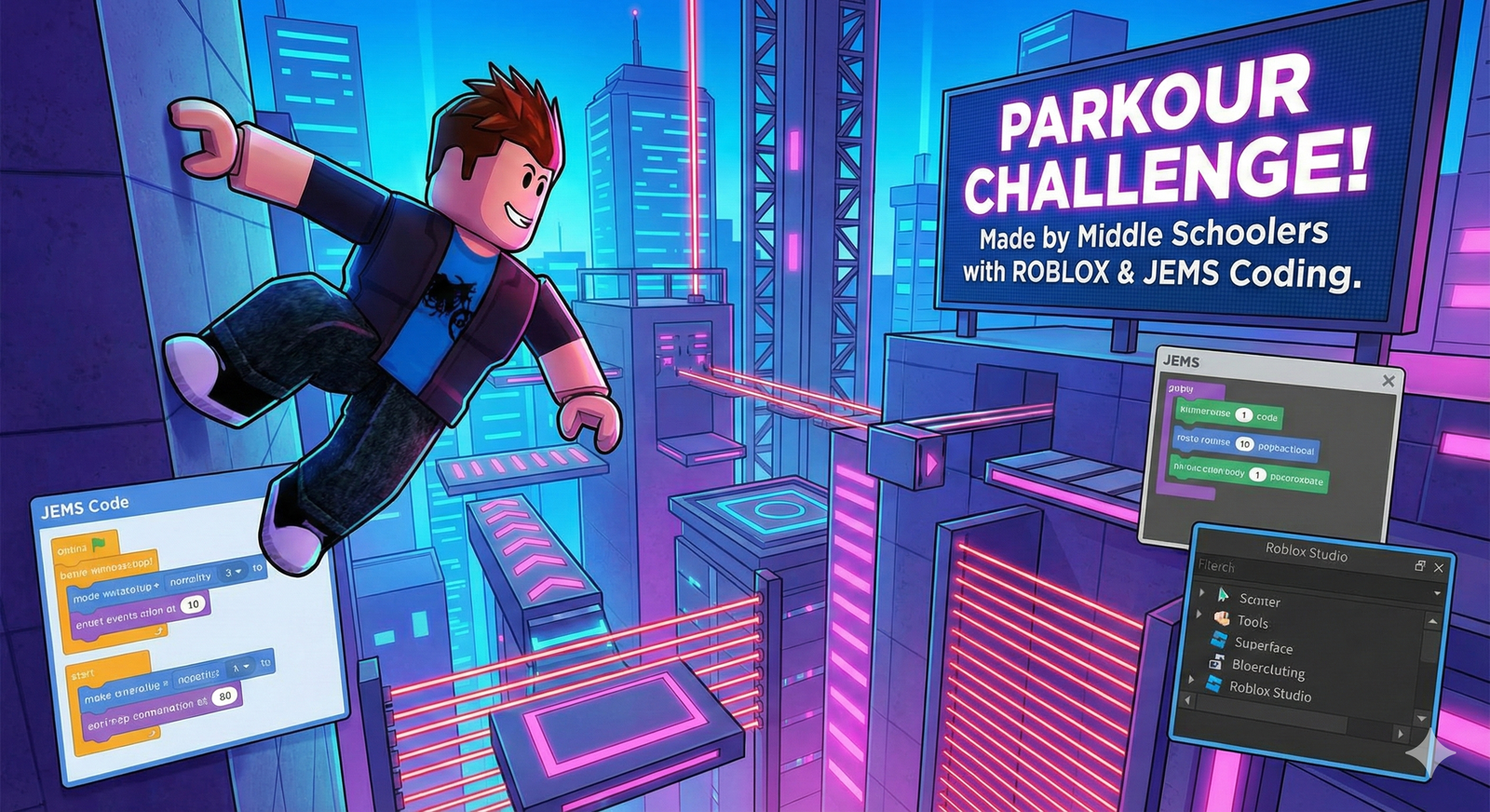
🚀 Capstone Project: Dynamic Parkour & Server-Side Physics Simulation
Students engineer high-precision raycasting collision systems and cloud leaderboards capable of supporting hundreds of concurrent players worldwide.
🎯 Tangible Milestones Your Child Will Confidently Articulate
Professional-grade software engineering competencies your child masters:
Physical AI: Bridging Onboard Neural Networks with Real-World Robotics
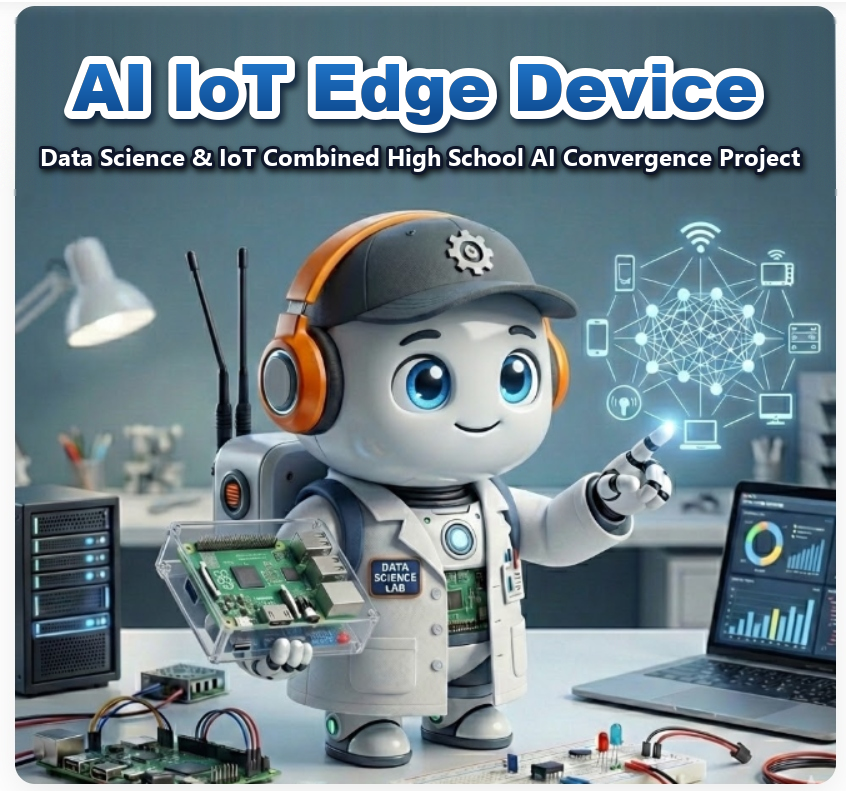
Artificial intelligence is breaking out of screen pixels into physical robots, self-driving vehicles, and automated cities. The Robome Vision AI & IoT curriculum unites Raspberry Pi 4 mini-computers, Arduino microcontrollers, and real-time computer vision, empowering teenagers to build physical edge devices that perceive and respond to the physical world.
🌟 How Robome Edge Hardware Cultivates Future-Ready Competencies
Mastering embedded systems, hardware-software handshakes, and autonomous physical feedback loops.
Inquiring into Embedded Systems
Students investigate edge computing constraints: *”How do we optimize neural inference models to run efficiently on an ARM processor under low battery voltage?”* Students master real-world edge AI and IoT systems architecture.
Cross-Layer Hardware Debugging
Debugging physical computing requires holistic systems thinking. Students trace signals across Python logic, serial communication buffers, and physical breadboard circuits, mastering unmatched deductive troubleshooting and grit.
Physical Human-Robot Collaboration
Students build autonomous physical systems: when the edge camera detects a specific traffic sign or gestures, the Raspberry Pi transmits serial pulse commands to Arduino servos, steering vehicles or sorting smart recycling bins in real time.
🤖 Embedded Edge AI Kit: Raspberry Pi 4 & Arduino Microcontroller
Students build hands-on physical AI prototypes integrating real camera sensors, digital-to-analog microcontrollers, and precision robotics hardware.
🎯 Tangible Milestones Your Child Will Confidently Articulate
Real physical robotics and edge AI competencies your teen demonstrates: